
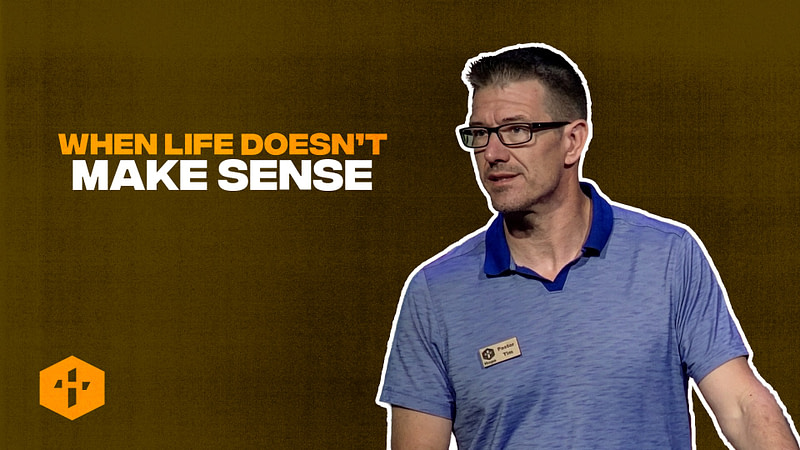
There are plenty of things in life we don’t understand. Some are funny and relatively unimportant. Why does an Airbnb have three remote controls? Why does someone with silver hair have a “Student Driver—Please Be Patient” bumper sticker?
But eventually, our questions become much more serious.
Why didn’t God answer my prayer? Why did someone I love get sick? Why did God allow this suffering? Why did someone who seemed to be faithfully following Him experience tragedy?
These are the questions that hurt.
Isaiah 55 speaks directly to those moments. God reminds us that when life doesn’t make sense, we can still trust Him—even when we cannot understand what He is doing.
Isaiah 55:6 says:
“Seek the Lord while he may be found; call upon him while he is near.”
At first, that might seem strange. If God is everywhere, how can He be “near”?
God is omnipresent. He is not limited by space or time. But Scripture also describes particular moments when God’s presence and work become especially evident to us.
Psalm 34:18 says:
“The Lord is near to the brokenhearted and saves the crushed in spirit.”
Sometimes it is precisely when life falls apart that we realize how far we have wandered from God.
The people Isaiah addressed understood this. Israel and Judah had repeatedly turned away from God and worshiped idols. They trusted in things other than the Lord, and eventually they experienced the consequences of their rebellion. They were defeated and carried into exile.
Yet even in their suffering, God had not abandoned them.
They had moved away from Him; He had not moved away from them.
We can do the same thing.
When life is going well, we can become distracted. Work, money, entertainment, sports, family activities, and countless other responsibilities can slowly push God toward the margins of our lives.
Then something happens—a diagnosis, a death, a broken relationship, a crisis—and suddenly our priorities change.
We pray. We open Scripture. We return to worship. We seek God.
God hasn’t suddenly become closer.
We have turned around and returned to Him.
Isaiah continues:
“Let the wicked forsake his way, and the unrighteous man his thoughts; let him return to the Lord.” —Isaiah 55:7
Returning to God involves repentance.
Repentance is more than simply saying, “I’m sorry.”
It means recognizing our sin, confessing it, and turning away from our sinful ways. Instead of continuing toward the next argument, the next selfish decision, or the next attempt to control everything ourselves, we turn around and return to God.
Think about what happens when two people are fighting. Each person believes they are right. Each person wants the other person to surrender.
Repentance begins when we stop fighting.
We lay down our weapons—our pride, anger, gossip, resentment, selfishness, and desire to control—and confess our sin before God.
And what does God promise?
Mercy.
Isaiah says that God “will have compassion” and “will abundantly pardon.”
That is grace.
Our sin is serious. God does not forgive us because our sin was insignificant. He forgives us because His mercy is abundant.
If you have ever wondered whether God could really forgive you for something in your past, Isaiah 55 points you back to God’s mercy.
Maybe there is something you said.
Something you did.
A relationship you damaged.
A decision you regret.
A season of your life you wish you could erase.
The answer of the gospel is not that those things didn’t matter.
The answer is that God’s mercy is greater than your sin.
We see that most clearly at the cross.
The cross shows us two realities at the same time. First, it shows us how seriously God takes sin. Our sin was so serious that Jesus Christ gave His life for us.
But the cross also shows us how deeply God loves sinners.
Jesus did not come for people who had everything together. He came for sinners.
The church is not a place where perfect people pretend to have perfect lives. It is a place where broken sinners receive the forgiveness and mercy of Christ.
Isaiah 55:8–9 gives us one of the most important truths for those moments when life doesn’t make sense:
“For my thoughts are not your thoughts, neither are your ways my ways, declares the Lord.”
God’s ways are higher than ours.
That means we will sometimes look at our circumstances and ask, “God, how can this possibly be good?”
We see one moment. God sees the whole story.
We see today’s suffering. God sees eternity.
We see the problem. God sees what we cannot yet see.
This does not mean every painful event is good. Scripture does not tell us to pretend suffering isn’t painful or that every tragedy has an explanation we can understand.
Instead, God calls us to trust Him when we don’t have the explanation.
The greatest example is the cross.
What looked like defeat was actually victory.
What looked like weakness was God’s power.
What looked like death became the means through which Christ brings life.
God’s answer is often different from what we would expect.
We expect judgment; God gives mercy.
We expect condemnation; God gives forgiveness.
We expect payment; God provides a sacrifice.
When life doesn’t make sense, we don’t have to understand everything in order to trust the One who does.
Isaiah 55 compares God’s Word to rain and snow that come down from heaven and water the earth.
God says:
“So shall my word be that goes out from my mouth; it shall not return to me empty.”
God’s Word accomplishes His purposes.
Scripture is not merely inspirational advice. God’s Word confronts us, corrects us, teaches us, comforts us, and points us to Christ.
Hebrews 4:12 describes God’s Word as living and active.
Second Timothy 3:16 reminds us that Scripture is useful for teaching, correction, and training in righteousness.
Romans 1:16 calls the gospel “the power of God for salvation.”
And John 1 takes us even deeper: the Word became flesh.
The Word is ultimately pointing us to Jesus.
When life doesn’t make sense, we naturally want answers.
But the cross doesn’t give us an explanation for every question we will ever ask.
Instead, it gives us something better: the assurance that God loves us and has not abandoned us.
We look to the cross because that is where we see God’s love most clearly.
Jesus died for sinners.
Jesus forgives.
Jesus conquered death.
Jesus rose again.
So when your prayers seem unanswered, when suffering overwhelms you, or when you cannot understand what God is doing, return to His promises.
Return to His Word.
Return to the cross.
You may not understand everything God is doing.
But you can trust the God who does.
And when life doesn’t make sense, that is enough.